


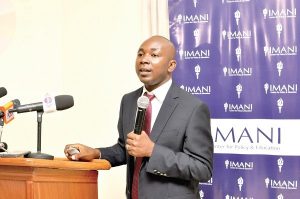
An economist and lecturer at the University of Ghana Business School, Professor Godfred Alufar Bokpin has taken a swipe on Ghana’s education system.
The Economist says the “easiest way to be unemployed in Ghana is to enter the university.” Prof. Bokpin was commenting at a policy dialogue on Covid-19 and its effect on Ghanaian businesses, organised by IMANI-GIZ.
The dialogue brought together private business owners and finance experts to share experiences on how they remained in business during the pandemic and the way forward.
Prof. Bokpin was of the view that, many businesses suffered because Ghana’s education system does not provide people with the requisite human capital development to think outside the box during such times.
He bemoaned the system’s failure to train up people to be creative on the job market rather than writing and passing examinations.
Meanwhile, Chief Executive Officer of the Chamber of Bulk Oil Distributors (CBOD), Senyo Hosi, held an equally view saying, “if you fail to learn how to drive Uber at the university especially”, your unemployment situation becomes worse.
He said the pandemic has affirmed the poor nature of the education system he’s been talking about.
“The fastest way you’ll be unemployed in this country is to go to the university. Because we are just creating people, not preparing them for a certain level of conditionality [and] because nobody did that strategic thinking to see what level of skill would be required at this point in time.
“We actually are just preparing for what people will test us in the short term just as the way we write our exams. We learn to pass but not to know. The orientation and cultural position must change,” he noted.
Tackling graduate unemployment
Mr. Hosi further spoke about the economic indices of the country saying they’re abstract and barely reflect the realities on the ground.
“We can’t keep talking about GDP. How are you looking at the development of your people? So you have to be talking about your Gross National Income, which talks about the income generated by your people. But it can’t end there. You also discuss your digit-index to see how well distributed that wealth is. Because if the inequality factors even show that the Gross National Index (GNI) itself is not proper, then you know you have a problem,” he explained.
Explaining his view further, he talked about formalising the economy to create more opportunities to absorb the teeming graduate unemployment which is on the ascendency on the continent.
“How are we formalising our economy to make policy interventions structured and impactful? Employment is at the heart of everything. We are in Africa, we have about a 100 million people waiting for us in unemployment over the next 10 years and that’s about 12 million coming out each year,” he indicated.