The Imposition of Restrictions Act; the ups and downs, and how it impacts the fight against Covid-19

On March 28, 2020, the Ghana Health Service (GHS) confirmed 141 Covid-19 cases nationwide, with five fatalities.
As part government’s measures to help curb the spread, President Addo Dankwa Akufo-Addo on Saturday, March 28, announced a partial lockdown on the Greater Accra and Greater Kumasi Metropolitan Areas from 01:00 am Monday, March 30, 2020.
Residents in affected areas were required to stay at home as much as possible for the next two weeks and will only be permitted to leave their homes for essential items such as food, medicine and water, or to visit the bank and public toilets.
Additionally, inter-city travel for private and commercial purposes, except for essential goods and services, were suspended.
But due to freedom of movement as enshrined in the 1992 Constitution, Article 5 clause 21 paragraph 1 sub paragraph g, the President’s restrictions needed legitimacy to be binding on the citizens.
This necessitated the passage of the Imposition of Restrictions Bill, 2020, on 20th March to give strong legal backing to President Akufo-Addo’s directives to deal with the threats posed by the Coronavirus.
The Bill had underwent intensive two-day amendments since it was laid before the House on March 18, 2020 under a certificate of emergency in accordance with Article 21 (4) (c) and (d) of the Constitution.
The Act vested the President with the powers to impose restrictions on persons in the event of disasters and emergencies in the interest of public safety, health and protection.
It also provides legal framework in dealing with cases of affront to the collective integrity of the country, particularly to the defence and disruptions in the running of essential services.
Read also: The effects of Covid-19 on the finances of Ghanaian women in SMEs
Even though the lockdown was lifted after a week extension to the initial two weeks, there are other provisions included in the act such as the wearing of face masks, observing social distancing and others that citizens are supposed to adhere to. Albeit the obvious flouting of the rules by many, peculiarly in the cities, people still walk freely without being arrested by the law enforcement agencies.
A drive from Achimota to the Central Business District of Accra could reveal hundreds to thousands of people disregarding the safety protocols as enshrined in the Act. But they walk freely without the police making any serious arrests. Even though the police could not make current statistics available to Ghanasonline, any arrests being made in connection with the protocols, would have been available to the media. That notwithstanding, information available to us few weeks into the passage of the Bill and imposition of restrictions shows the police were making arrests during the lockdown but have indubitably quenched their fire.
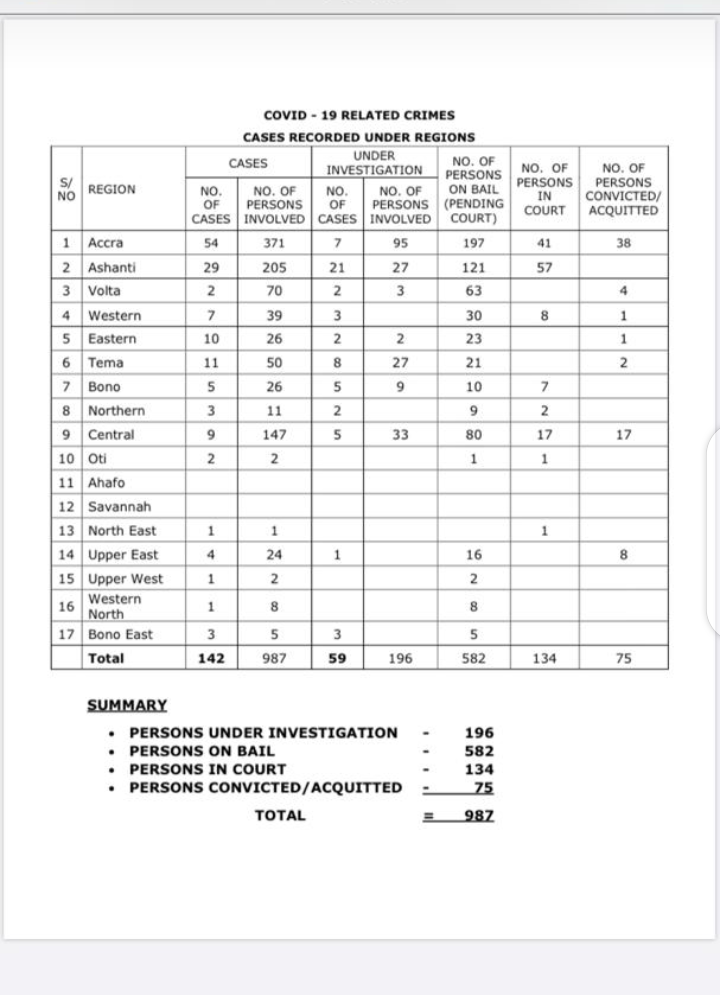
In as much as the police cannot say they’re tired of apprehending people for flouting the rules, as an officer disclosed to us on condition of anonymity, the team decided to scrutinise the Act itself, to ascertain how good or bad it is, and what could probably make the police relinquished their responsibility of arrest.
Ghanasonline has been engaging the expertise of private legal practitioner, Martin Kpebu, to look at the Act and how it has influenced its implementation.
He says even though the Imposition of Restrictions Act, 1012 has beneficial provisions to ensure public safety, it did not give sufficient time to prepare because “desperate times require desperate measures”. However, in the same act, there is this draconian provision about the punishment, which is the infamous Section 6.”
“A person who fails to comply with a restriction imposed under the Executive Instrument issued under subsection (1) of section 2 commits an offence and is liable on summary conviction to a fine of not less than one thousand penalty units and not more than five thousand penalty units or to a term of imprisonment of not less than four years and not more than ten years or to both”.
The minimum penalty units stated in the section is GHC12,000.00 according to Mr. Kpebu, which he says the offences in the Act should not warrant the punishment he describes as draconian.
According to him, juxtaposing Ghana’s punishment regime with other neighboring countries, the fines they pay which ranges from $50 to $200 is economically reasonable as compared to Ghana’s whopping $2000, in a low level income country like Ghana.
“People are earning about GHC 300 a month from the last checks I made. The National Service Personnel earn GHC 559.00 a month, so if you prosecute one of them now, he’ll use a little over 2 years of his entire salary to pay that fine and the service is even just a year. The Nation Builder’s Corps (NABCo), are taking GHC 750 and they’ll use about a year and a half to pay for that fine. That is, if they are given the minimum fine of GHC 12,000 which I am using as the benchmark. Now, in Ghana, unemployment rate is very high. There are millions without jobs so when you prosecute them, they can’t pay”, he analysed.
Mr. Kpebu has also described the sentencing regime as “grossly disproportionate with the harm it seeks to cure, and is aimed at destroying families because, if you arrest one Makola petty trader, she feeds about four mouths and she’ll use all her capital to pay that minimum fine of GHC 12,000.”
He explained that, the punishment are gross human rights violations and makes the law a bad law because, it does not take to account the economic circumstances of the person who has flouted it.
He again suggested, “because the law is so draconian, that is why the security agencies are not arresting people left right centre. So it appears because of that, they’ve exercised restraint with prosecution.”
He suggested further that, government does a broader stakeholder consultation in amending the Act, in order to right the wrongs, with the key sense of drastically reducing the punishment to reflect the economic realities of the citizenry.
“Our prisons are already over congested. So I think on the 1st and 2nd offences, there should be a fine and perhaps some education so that on the third occasion, before you send the person to jail”, he insinuated.
He finally admonished more public education, especially in the local languages, adhering to the safety protocols and government making the masks available at places where they’re lacking, in order to tackle the pandemic holistically.
About The Author