Ghana likely to revert to IMF by end of 2021 – Economist predicts

An Economist has predicted a probability of Ghana reverting to the International Monetary Fund (IMF) for fiscal resuscitation.
Dr. William Godfred Cantah, who lectures at the University of Cape Coast said this is as a result of the poor revenue mobilisation for the past recent years, resulting in increased debt to Gross Domestic Product (GDP) ratio.
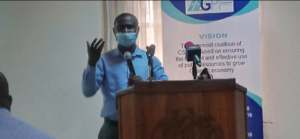
“If you look at the way our debt to GDP is going, and the fact that for the past three years we’ve had continuous reduction in revenue mobilisation, then there’s that possibility that, we’ll have no choice than to go to the IMF,” he told told Ghanas Online on the sides of a round table discussion of an ‘assessment of Ghana’s economy over the past 8 years’.
The programme, organised by the Economic Governance Platform, funded by Oxfam, analysed how Ghana has fared at the various sectors of the economy over the period in perspective.

Dr. Cantah, who was the main Speaker at the event after leading the research noted government will take the move by close of 2021 or early next year.
He, however, averred government can only avert that possibility by increasing it’s revenue mobilisation to close up the revenue gap.
Read also: Ghana’s debt stock rises to 74.4% of GDP, now at GH¢286.9 billion
The Economist noted the tax leakages in the system amongst other things must be blocked, whilst roping in more people from the informal sector to the tax net to remedy the situation.
Let alone, Dr. Cantah advised against the habit of governments overspending in election years.
The statistics as depicted by the available data was evident that, government deficit during electioneering periods skyrocketed.
He stressed “election years are not the end of the world for us and [so we must] do the right things to ensure the continuous stability of the country and we wouldn’t have to always run to the IMF for support each time we destroy our own created system.”
Touching on graduate unemployment, he admonished policy makers to modify the educational system to “produce more producers than managers.”
Derivative markets, he added, must also be developed to make the agricultural sector more lucrative and attractive to the youth.
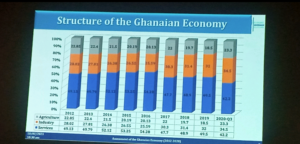
He indicated rural urban drift is on the ascendency due to the unattractiveness of the agricultural sector which hitherto was the driving force of the Ghanaian economy.
The research also revealed the Service sector as the current drive of the Ghanaian economy with Oil and Gas and Information Communication Technology (ICT) being the pivots.
However, these two areas (Oil & Gas and ICT) are sadly dominated by foreigners in terms of human resource.
It was therefore learnt that, profits from these foreign owned enterprises are repatriated to their mother companies, increasing the demand for the dollar and subsequently depreciating the Cedi.

It was recommended for government to adopt robust fiscal policies and employ feasible measures that will propel Ghana’s economy, going forward.
About The Author